
The Path to Breath Awareness
The Path to Breath Awareness
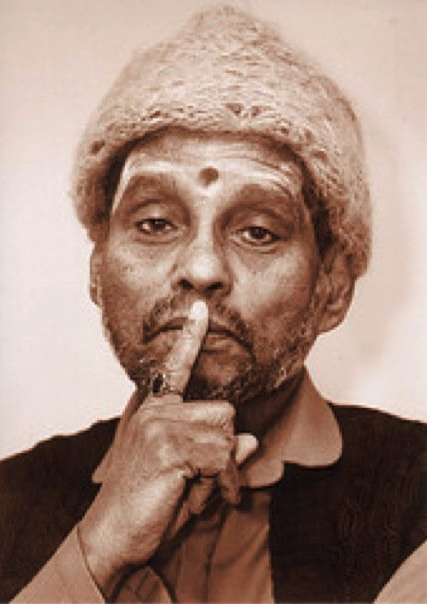
(Pictured, lineage teacher Swami Muktananda)
A Note on this Section: It is a little longer than the others, but written in a way that is intended to be digested in small bits over time. Each small essay focuses on a singular aspect of breath meditation, and can be worked with a little bit on its own to deepen the overall effect of your practice. Try reading just two a day, and working with them, before moving on. Always remember, that the guided practice section is here to directly support your experience of the breath, and is very comprehensive. Let us know if you have any questions, we hope you enjoy it!
The Breath is a Riddle
What can you feel but not hold? Sail with but not ship? What is a current, a flow of energy, that we can learn to ride, but only momentarily guide? To hear it speak we must stop speaking, to feel it move we must stop moving. What is this subtle energy within us that both nourishes and propels us, at both the cellular and subtle levels? By now you likely know that we are talking about the breath, but in reality the breath is a true riddle, something our mind can’t quite wrap itself around, something we can only ‘sense’ but is also beyond the senses. For all of these enigmatic reasons, the breath is considered an advanced tool on the path of meditation, although of course, it is the most intuitive and natural tool. In the following short essays we will explore three aspects of the breath: The physical, the subtle, and the causal. These three layers of the breath take us towards an experience of it that goes beyond mere comprehension and into its connection to our very being.
Part One: The Physical Breath
Silence
If the mind is the slayer of the soul, as multiple traditions have observed, then you might also say that the mouth is the slayer of the breath. The breath truly begins when our mouth closes, which is often harder to accomplish than we realize. It is through our mouths that we express ourselves and navigate our reality, and without our words, we might assume that we will lose touch with reality. In fact, through the practice of silence we often find just the opposite: that we feel even more connected to the space around and within us. This is why silence has always been a subtle teaching of the Yogic tradition. One of Swami Muktananda’s most famous teaching images is of him holding his finger to his lips, encouraging the aspirant to not only quiet their tongue, but more importantly, their mind.
As ShambhavAnanda teaches:
“The keys to your problem are regular meditation and not allowing yourself to get too distracted. When you find yourself obsessing about someone or something, you have to stop it. Shut your mouth. If you can shut your mouth you have taken the first step towards shutting your mind down. You may wonder, “If I am mindless who am I?” You become a functional human being, a real person. That’s who you are” (SP, 83).
Quiet mouth, quiet mind — a simple yet profound teaching for all of us to explore in our own ways. In the ancient texts which describe the attributes of the Goddess Kali, we see a similar teaching, which author David Frawley comments on: “Her opponent is the ego. She pulls out the tongue of the ego, which is the attachment to gossip, opinions, and all negative speech patterns that are the essence of the small-self focused mind.” Quiet tongue, quiet ego — it might be that simple.
Observing silence is a worthy endeavor for anyone looking to deepen their experience of the breath and their practice in general. Mataji Ma Yoga Shakti, the first female Mahamandaleshwar in the history of the 2,000+ year Saraswati order of Swamis, and the initiator of Sri Shambhavananda into the order in 2006, teaches about the value of silence in her book A Spiritual Message. She writes:
“Begin your search for peace in the following manner… Observe Silence! The easiest of all spiritual practices is SILENCE. Embrace Silence! …If you observe silence you will be able to listen to the voice of your soul. You will understand the language of your soul. You will grasp the message which your soul wants to convey.”
The silence of the mouth, and the mind, is what allows us to hear our soul. Much the same can be said of the breath, as without closing our mouth, we can’t begin to really interact with the breath at its subtlest level. So you could say ‘Close the mouth, quiet the mind. Hear the breath, hear the soul.’ It’s a physical gesture that could open up a metaphysical doorway for you. Make a commitment to observe silence at some point this week, and see what you can learn from it.
Free Write
After taking time to practice silence in a way that works for your life and practice, reflect on your experience. What is the difference between ‘not talking’ and ‘observing silence’? Did this simple practice have any subtle effects for you?
The Nose knows
Once we are able to close the mouth long enough, we begin to get a sense of the mechanics of breathing through our nose. When the mouth is closed, and you swallow, you will notice a subtle suctioning that occurs in the back of the mouth as the tongue gently rises up to meet the soft palette. This is a very subtle form of the Khechari Mudra, a subtle bandha, or bind, that can help to retain your energy and focus. It is not a gripping sensation, but a very natural one we simply have to allow to occur and support.
On a physical level, this subtle lift initiates what is called the Deep Front Line: your deep supportive core musculature, of which the diaphragm — the main respiratory muscle — is a part. The Deep Front Line is a series of separate muscles which work together via their connective tissue. This team begins at the big toe, connecting up to the deep calf muscles of the Tibialis Posterior, then the deep thigh muscle of the Adductor Longus, next the deep pelvis muscles like the Psoas (the primary muscle for walking), then the deep torso muscles like the diaphragm (the primary respiratory muscle), and finally connecting up to the tongue. There’s a reason karate chops and tennis serves are always accompanied by a “hiya!” We can feel the connection of the tongue and the core just by doing an ‘air chop’ right now. So with the slightest, gentlest engagement of the tongue at the roof of the mouth — which is a natural result of swallowing and keeping one’s mouth shut — we retain this very subtle core engagement. This allows the diaphragm to breathe more efficiently, the core to more buoyantly support us, and the mind to keep us focused.
It is possible, and recommended, to explore breathing through your nose on and off your meditation cushion. There are many scientific studies which show the benefits of nose breathing. One fun fact is that nose breathing absorbs 18% more oxygen than mouth breathing (J. Lundberg, “Nasal and oral contribute to inhaled and exhaled Nitric Oxide: A study in Tracheotomized Patients”, 2002). Think about that for a moment — 18% is 1/5 of your total oxygen intake, that’s a lot! Other studies show that mouth breathing itself causes more cavities than sugar consumption, bad diet and poor hygiene — that’s pretty remarkable, and that data has been around for over a hundred years! (“Breathing through the mouth a cause of essay of the teeth,” American Journal of Dental Science, 1890). Evidently, breathing through the nose is beneficial in all fields, from sweeping to sleeping, running errands to running miles. If this is new information to you, don’t be alarmed. Take your time and try it out throughout your day. It should feel natural and nourishing.
One of the benefits of meditation is that it allows you to reset deep patterns, both on a physical and subtle level. When you take time to consciously breathe through your nose while you sit for practice, it can also be a way of re-programming your daily habits from the inside out, allowing the many benefits of nose breathing to infuse throughout your life.
Free Write
On a physical level, what is your experience of breathing through the nose? Is it challenging? When you try it during your day, how does it affect your mind and focus? How does it affect your experience of the breath itself?
Walking
Watching our breath is a cue that is often used in a breath meditation practice, but anyone who has put time into their practice knows, this can be a very challenging task. This is because the minute our mind turns its attention towards anything, it starts to manipulate it. So instead of watching the breath, we end up pushing and pulling it. One very helpful step you can take towards feeling your natural breath flow, without the manipulations of the mind, is to actually go outside and take physical steps while watching your breath. That’s right, the key to watching your breath might come from taking a walk.
This is because your body and breath are literally hard wired together. On a neurological level, numerous studies have shown that walking improves self-perception and self-esteem, mood and sleep quality, as well as reducing stress, anxiety and fatigue — all of which can help you calm your mind and find your breath. On a physical level, your body also uses the power of walking to support the mechanical inflating and deflating of the lungs. This is because many of the muscles we use to walk, such as the psoas muscle (deep hip flexor) and the intercostal muscles (muscles between each of our ribs), are both muscles of walking and muscles of breathing. All of this simply means that you might be able to feel and focus on your breath more effectively while walking, which makes it a great first step in getting to know your breath.
To begin this process, pick a destination that will allow you at least five solid minutes of steady walking without too much incline, decline, stopping or starting. From there, find a comfortable and natural pace. This is not intended to be a ‘slow meditative walk,’ but must be a natural experience of walking— this is pretty important. Let your arms swing a little, let your torso gently rotate, feel the feet land in front of you and traction their way behind you before being effortlessly flung forward — you know, let yourself walk! At first your walk might be a little over-done, but eventually you’ll get a natural pace going, and that’s when you can start to find your natural breath. Try not to force yourself to breathe at a certain count, or with your foot steps, or even with a mantra — just let yourself breathe as naturally as can while you continue to walk naturally. It will take time for the mind to settle down and let the breath flow with your footsteps, which is why you want to do this for at least 5 minutes.
What you will discover is that your mind doesn’t interfere with your breathing as much because you have your footsteps to focus on. The act of walking also creates a rhythmic experience that naturally calms the thought waves. Eventually this allows you to directly experience your breath in a natural and sustained way. You can feel the experience of your inhale as light and expansive, and your exhale as centering and surrendering. You might find that you can focus on your breath for 20 minutes effortlessly while walking, whereas 5 minutes on your cushion might still be a challenge. You might also find that sitting after this practice helps you find your natural breath flow easier than without it. Walking can become a great preparation for your practice, yet another tool that can help you relate to this invisible friend, our breath.
Free Write
How did it go? Did you find the act of watching your breath easier while walking? How long did it take you? Did it help you relate to your breath while sitting?
Stillness
When you have an appetite for food you naturally appreciate all the subtleties and flavors, and the food seems to just infuse into your very being. On the other hand, without an appetite, you may feel disconnected from the experience, or that act of eating itself is a chore.
This is also many people’s experience of the breath during meditation — we are breathing without an appetite for it, either pushing and pulling it with doership, or our minds wander while the breath chooses by us. We need to generate an appetite for the breath so that we can begin to experience a whole new way of interacting with it. But how do we do that? Do we run around in a circle until we are ‘out of breath’ and then meditate on our breath? Although that seems like a joke, there is a little bit of truth to it that we will touch on later. For now there is an even better way of generating an appetite for the natural breath that you can do from the comfort of your meditation seat — practice stillness. Stillness is the greatest resource for generating an appetite for natural breathing, and is a tactile practice that anyone can do no matter how busy the mind may seem.
The trick to stillness is finding the right balance of effort and effort-less. We can’t maintain stillness from the mental or physical will — that only creates tension in the body and mind. However, we must exert some degree of effort to maintain true stillness; unfortunately it’s not as easy as laying down on your mattress! The effortless effort of stillness can be understood as buoyancy — a buoy floats on the surface of the water effortlessly, but try to push it down below the surface and you will soon feel how much silent effort resides just below it’s surface. Our body is meant to sit up straight without much effort; it’s how we are both wired and structured. All we have to do is learn to participate with it harmoniously. That’s where buoyancy comes in.
One of my favorite ways to access buoyancy in my seat is by using the teachings of the Vijnana Bhairava, a 4,000-year-old Yogic text on the practice of meditation. Dharana 57 teaches, “When on a bed or a seat, let yourself become weightless, beyond mind.” And I have always found Dharana 58 to help accomplish this goal: “In a moving vehicle, by rhythmically swaying, experience. Or in a still vehicle, by letting yourself swing in slowing invisible circles.”
To play with this we can imagine ourselves like a buoy in the ocean, swaying rhythmically in slightly unexpected directions, in ‘slowing invisible circles’ as the text writes. Now imagine the currents of the ocean becoming increasingly still, until you also become still, ‘weightless’ as the text teaches, 'beyond mind’. When you can access this level of stillness through effortless effort, you will feel a stirring inside, an appetite beginning to form. If you maintain this level of stillness, you will feel the only thing moving in you is the breath, and that subtle movement is like a nectar you will begin to savor. If and when you move, you will find the appetite starts to diminish, and the moment you become still again the agni (digestive fire) within your psychic system perks back up. Eventually this appetite for breath, derived from organic stillness, will be a powerful means by which you can consciously access the otherwise unaccessible pranic power of the breath. What is perhaps the most important by-product of this method, though, is that it lets you use effort without getting in the way of the process. The breath begins to flow naturally for once, instead of being pushed and pulled by the will, or overlooked by a distracted mind.
Take time for stillness at the beginning of your breathing meditation practice. It might be the one ingredient you overlooked, and the one that makes the meal divine.
Free Write
Experiment with the balance of effortless effort in your meditation seat— how do you achieve it? Notice the relationship real stillness has with your ability to let your breath flow naturally.
Part Two: The Subtle Breath
Threshold
When you fall asleep at night, your entire being falls asleep with you. Accessing this subtle aspect of our nature is not something the mind or body can do on their own; it’s a package deal. Sleep and meditation are similar in that they both recharge us from the inside out, but unlike sleep, which we do from day one, learning to go to that subtle interior space without losing awareness (meditating) is a life long journey. For that reason, as we begin to access this expansive and nourishing space within us, it is not uncommon to feel sleepy, or fall asleep. As your practice grows, you will naturally gain the inner capacity to pass through this threshold without losing awareness, and then at another stage in your sadhana, you will feel this threshold strongly again. It is a part of the process for all stages of meditator.
In his commentary on Shiva Sutra 2.10, Lakshmanjoo writes,
“This losing awareness is the great crisis in the yogīc world. All yogīs generally experience this state of losing awareness. And when they do, they go to the dreaming state because that state is subtler than the waking state…When, through meditating in continuity, your thought becomes ever more subtle, you will feel that you are about to go to sleep. Sleep comes for those who can not maintain awareness. Those who can maintain awareness do not fall asleep. They enter the gap, the junction of these two states of waking and dreaming. That junction is turya, the real state of being.”
As we see in the sutra, the feeling of sleepiness, of losing awareness, is something yogis have always worked with in their practice. When we feel it, we can see this sleepiness as a doorway, a threshold — maintain your awareness and pass through it to a higher state of awareness. Lose your awareness, though, and your head will bob as you fall into a dream. And we can all practice patience with ourselves, because it might take a dozen passes through this threshold before we make it through consciously.
The experience of approaching and passing through this very real threshold of the breath is not unlike the pressure you might experience when ascending in altitude in a plane, or diving down in the water. In the physical world, these thresholds show us how all-pervasive the experience can be; it’s a sleepiness that comes at you from all angles. In the world of meditation, you will learn to recognize this pressure as an indication that you are encountering a warehouse of energy, an expansiveness that your current level of awareness simply can’t contain. Don’t try to contain it, simply focus on maintaining your awareness, and let yourself approach and eventually pass through this threshold. It’s not a matter of effort — it’s a matter of surrender (which of course is a unique kind of effort, but not the kind we normally define it as). The key to passing through this threshold is not based on feats of strength or magic, just good old-fashioned effort over time.
Free Write
Have you experienced the threshold of sleepiness when meditating on your breath? How have you, and do you, work with it consciously?
Mantra
The breath is like the wind, invisible to the eye— for this reason, bringing a mantra to your breath can help illuminate this invisible force within us, like chimes blowing in the wind. The difference between a mantra like “Om Namah Shivaya” and a breath based mantra, is that we don’t repeat a breath based mantra out loud, we repeat it silently as we feel our breath. For this reason, repeating a mantra with the breath both supports our focus, but also requires a high degree of focus. Which is why it can be helpful to take time to look at how the Yogic Tradition describes how to use a breath based mantra.
The mantra used in conjunction with the breath by the ShambhavAnanda Lineage is “Ham Sah,” which means ‘I am That.’ The mantra ‘Ham’ is repeated silently with each inhale, and ‘Sah’ is repeated silently with each exhale. The translation of the mantra is itself a teaching, as Swami Muktananda tells us in his text “I Am That”: “The syllable ham…is the seed mantra of the Self...This aham, this I, has two forms. One is the ordinary I-consciousness, the ego sense, which identifies itself with the body and senses, which considers itself to be man or woman, American or Spanish or Indian, black or white. The other I is the true aham, the pure I-consciousness, and this I is God. The ordinary I is consciousness in bondage. The pure I is consciousness in the state of liberation. As you repeat hamsa with the understanding of the perfect aham, this realization dawns.” (Note: There are no page numbers in this book)
As Swami Muktananda teaches here, the meaning of the mantra dawns in us as we practice the mantra. We all start from a space of limitation, associating ourselves with our personalities, likes and dislikes. But over time, as we watch the breath, this identity melts away and a realization of the real “I” to which this mantra points us, awakens. The actual practice of the mantra itself yields the experience of its meaning, and this points to the subtle practice of Ham Sah as well. Because we find that even repeating the mantra with the breath itself takes a certain quality of effort—as Swami Muktananda teaches in that same text: “This is what we also need to understand. Hamsa is not a mantra that you merely repeat. What you have to do is become established in the awareness of the mantra going on inside you, in the goal of the mantra, in the pulsation which exists in the space where the syllables arise and subside…”
The subtle teaching here is to go beyond the assumption that we are repeating the mantra, and instead try to feel the mantra of Ham Sah repeating itself through us as we breathe. Yes, we start by repeating the mantra clearly in our mind/heart as we breathe, but as our mind settles down, we want to try to let the breath, and the mantra, happen naturally. We go from repeating the mantra to feeling the mantra repeating itself.
One practical method to help you do this is to explore the qualities of sensation associated with your breath, to look deeper into the experience of your inhale and exhale, and to associate those qualities with the mantra. For example, the inhale is more than just a breath inwards, it’s physically cooler and can be felt in the nostrils and throat, it’s also a physical and subtle experience of expansion and light. When we feel these qualities as we inhale, it is easier to repeat the mantra Ham from a space of felt-awareness, instead of just rote memorization. The exhale is more than just a breath out, its a full body release of stress and tension, and naturally draws our awareness to the navel as our body contracts to dispel the CO2. It is also a deep experience of letting go, or surrender— all of these qualities can be joined to the mantra “Sah” to help you ‘become established in the awareness of the mantra going on inside of you’ as Swami Muktananda taught. In this way we see that using a mantra like Ham Sah as we breathe is an incredible opportunity to feel the subtlest level of our mantra practice, and the very pulsation of life itself.
Free Write
What is your experience of the Ham Sah Mantra? How do connect with a deeper experience of the mantra, to ‘become established in the awareness of the mantra going on inside of you’ as Swami Muktananda taught?
Exhale
It should be noted that you can also repeat this mantra as “So Ham, ”which translates to ‘That I Am.” In this version of the mantra, we begin by repeating the mantra “So” with our exhale, and then repeat “Ham” with our inhale. Swami Muktananda taught that both of the mantras (Ham-Sah and So-Ham) are equals, and that a practitioner can use the one that best suits them.
The exhale-based mantra, So Ham, can be helpful because it allows you to bring your initial focus to the exhale, which has been shown scientifically to be the most overlooked, and yet most important, aspect of our breath. Studies have shown that longer exhales allow for a better balance of the CO2 and O2 levels in our lungs and blood, allowing for more oxygen absorption overall. In fact, the cue to ‘take a deep breath’ is usually counter-productive as there is a general tendency to over-breathe in our culture, as shown in numerous studies. Without a proper exhale, you can inhale all you want, but your body can’t assimilate the oxygen. And if the inhale gets too over-powering, you actually invite a whole host of problems associated with over-breathing, also known as hyperventilation. Patanjali also wrote that between the two, the exhale is more important because “when you clear the pipe, the water must flow,” meaning that a well-performed exhale naturally invites a beneficial inhale. Try it for yourself and see. For those reasons you might enjoy the So-Ham mantra, but of course all of those benefits are possible with either mantra as long as you take time to allow the exhale to end in a natural way.
Free Write
Have you tried the So-Ham method? Which do you prefer and why?
Shambhavi Mudra
Another method for helping us ‘cross the threshold’ into our subtle breath is the practice of meditating with one’s eyes open — in Sanskrit called the Shambhavi Mudra. This enables us to stay more alert while accessing the subtler realms of awareness. ShambhavAnanda teaches:
“The Shambhavi Mudra is learning how to see inside with your eyes open. My name is Shambhavananda. It means to be immersed completely in your Inner Self while all five senses are working. You can’t close your eyes to the world and to the things that are of it. It is easy to close your eyes and daydream; it is more difficult to be present right here and now…. It is easy to lose focus with your eyes closed—at least until you have established a really solid practice…The Shambhavi Mudra does not involve staring, it is recommended to use a relaxed and soft gaze. Even if you close your eyes, the rest of your five senses are working. You have to learn how to discover your Inner Self without being completely manipulated by all the input that you are getting from the five senses, much of which is wrong” (SP, 53).
As ShambhavAnanda teaches, it may seem that having the eyes open is more distracting, because there is more stimulation to your mind, but having the eyes closed and losing yourself in thoughts is even more distracting than that in the long run. In the beginning, most students prefer to meditate with their eyes closed for a variety of reasons, even if just for the physical comfort, but as a student becomes more serious in their practice they will soon be able to recognize the benefits of open-eyed meditation. Early in our practice, but really at many stages of our work, we are caught in the distractions of our mind so thoroughly that we don’t even know we’re not doing our practice. Eventually one learns to recognize this and can make an informed choice to begin an open-eyed practice, but until the student is able to recognize the state of their own mind, they may not recognize the benefits of the Shambhavi Mudra. That’s ok, it will be there for them when they’re ready. In the mean time, it’s good to know that the Shambhavi Mudra is endorsed by three generations of realized teachers in the ShambhavAnanda Tradition: Root Guru Bhagavan Nityananda practiced it constantly, Swami Rudrananda taught it exclusively, and Shambhavananda not only practices it but is named after it. So take your time, but be sure to open the door to this valuable asset on your path to subtle breath awareness.
The Shambhavi Mudra is different than a drishti we may hold in a yoga class to aid our balance, which is more like staring at a single point. This open-eyed focus is on a general area of focus, with a very soft drishti. The accompanying video helps to illustrate the subtleties of this mudra.
Free Write
What is your experience of Open-Eyed meditation? How does it benefit your practice?
Part Three: The Causal Breath
Flow
Patanjali concludes his commentary on pranayama with the following teaching: “Besides these [aforementioned] methods of altering the breath [pausing the breath, focusing on different parts of the body, changing the volume of the breath, and so on] there is another, more subtle approach to pranayama which transcends the concept of the breath existing merely inside or outside of the body” (2.51). This shows us that the ultimate pranayama, the ultimate experience of our breath, goes beyond pushing or pulling the physical breath, and is simply the ability to flow with our breath. But as we know for experience, simple doesn’t always mean easy.
The challenge of finding this experience of the breath is that it requires that we use less and less effort while maintaining more and more awareness. It's like trying to catch a soap bubble, the effort required is the patience to let it land on you — not grab it. If you reach out for it, it pops, but if you move with it skillfully enough, it arrives. This alludes to the deeper practice of meditating on our breath, which Sri Shambhavananda describes in this passage:
“Think of the breath as a vehicle rather than a jackhammer. Often students use the breath too strongly. You should attach your attention to your breath in a way similar to the way you attach your attention to a mantra. If you are sitting and beginning to still your mind, and you are also consciously using the breath, you will be totally with the experience of the breath. You will not be using the breath to cut the rock open. Instead, the breath is a vehicle that you are riding on, and you are consciously feeling it move through the chakras, or at least to experience where they are. For example, when you take a breath in, you can feel the heart chakra. You do not try to tear and rip it open with willfulness. The breath is like a massage, and as you exhale you surrender all the negativity that gets kicked up. When students are able to be open and simple with their breath, they realize that watching the breath is not the same as trying to control it. The pranayama within the breath is simply flowing with the breath.”
Babaji is teaching us how to work with the breath: to think of it like a vehicle we ride on, not pry on. It’s a way to massage or release a knot of tension, not create more tension. When massaging a muscle, you have to exert effort, yet you must remain receptive. You have to move with feeling, and in a similar way, the highest goals of working with our breath is be able to breathe while remaining receptive. We are trying to dance with it, to feel its gentle lead, and move without stepping on its toes. Try to change your attitude of inhaling from ‘taking a breath’ to ‘receiving a breath’— how does this change your experience? This ‘merging’ with the flow of the breath represents the supreme experience of conscious breathing. As Babaji says, ‘the pranayama within the breath is simply flowing with the breath,’ meaning that the ultimate practice of breathing is not to push or pull our breath in any way, but to allow the breath to breathe us. As Swami Muktananda describes it:
“In the [natural breath meditation] practice of ‘ham sah,’ the mantra takes place on its own, and the goal of the mantra is the Self. It is That which repeats it, it is That which is its goal, and it is That which is attained by repeating it. When the mantra, the repeater of the mantra, and the goal of the mantra become one and the same for you, you attain the fruit of the mantra.”
Ultimately, our work with the breath is bringing us to the experience of the pulsation of energy itself, beyond the tools, beyond the practitioner. The Yogic concept of Spanda is the energetic pulsation at the core of reality, the dance of Shiva and Shakti that creates all of manifestation. As Christoper Wallace describes it in Chapter 12 of his commentary on the Pratyabhijnahridayam, “Awareness is a pulsating, oscillating, vibrating, dynamic force (Spanda) that accomplishes everything and transforms itself into all the objects of experience.” Spanda pulses through us just like our breath, but it operates at the subtlest level of reality. When we merge with our breath, we are merging with the dynamic energetic pulsation of life itself. At this level the tools themselves dissolve, as Patanjali describes it in Yoga Sutra 3.2 and 3.3:
“Dhyana, or meditation, is when the focus of dharana becomes a steady, uninterrupted flow of attention. Here, the separation between the practitioner and the object dissolves. Samadhi [merging] is when, in the practice of dhyana, both the practitioner and the object of focus dissolve into the Self. Then there is no such thing as practitioner or object, only absorption in the Self.”
These mountain tops of experience are the result of skillful effort over time— they can’t be forced, and they don’t need to be. Merging with breath flow, feeling a pulsation of life force, going beyond the tools and directly experiencing a state of being are experiences that come to us when we are working whole heartedly and giving ourselves to the process. So don’t let your mind get in the way, let the experience of merging with your breath come to you. In fact, according to Jai Deva Singh’s commentary in Shiva Sutra 1.7, this is the true purpose of all yoga practices— to prepare to receive the descent of Grace, the merger of the Self.
“Then why all this pother about gaining the Turya consciousness? What is the value of the Upayas or Yogic disciplines mentioned in the Siva-Sutras? The answer is that though it remains as the background of all we are and do, we are unaware of it. It is not a feature of our normal consciousness. The Upayas are mentioned so that we may prepare ourselves for its reception” (40).
Like our awareness itself, the breath is happening in the background of all that we do, and we are generally unaware of it. Our work with the breath is a way of turning our attention to this gentle pulsation at the core of our being. At first, when we turn our focus towards it, we can only feel our own effort. This is where we begin. But over time, with the right tools, attitude, and discipline, we are able to slowly release our hold on the breath while retaining our awareness of it. This is the experience of true breath awareness, the experience of flowing with our breath. In this way, ‘watching our breath’ is much more than a cue, it's a state of being.
Free Write
How do you relate to the concept of the breath as beyond the physical inhale and exhale?When you sit to practice, how do you work towards the experience of ‘flowing with the breath’? Do you feel you have had this experience before in your practice?
Poem
I’d like to finish this section with a poem I wrote on the experience of watching the breath, in-joy!
“Arriving”
Observation is a practice that reveals
Subtle beauty that is right in front of you.
Sit and watch something for a minute,
Set a timer if it helps,
and watch how much work it takes
to watch something.
Your eyes want to stare at a point,
Soften your focus a little,
See the object and the space it’s in,
Watch the subtleties of it’s movements,
Like a tree branch lightly bowing in the wind,
Insects moving across it so naturally,
one.
This work prepares you to watch
The pulsation of your breath.
It moves within you
As naturally as the bugs moved across the leaves,
one.
Focus and re-focus,
Play with the interaction of
observation and the
inevitable manipulation—
Like a see saw,
Let the weight of the kid
On the other end
move you—
This is the play
Of watching your breath,
Always unfinished
Until